


History
 The Palm Beach County Department of Airports operates and maintains President Donald J. Trump International Airport in West Palm Beach, Palm Beach Park Airport (LNA) in Lake Worth, Palm Beach County Glades Airport (PHK) in Pahokee and the North Palm Beach County Airport in Palm Beach Gardens. President Donald J. Trump International Airport is the center for all commercial air carrier service into Palm Beach County. Palm Beach Park Airport and North Palm Beach County Airport are general aviation airports serving private and corporate airplanes. PHK serves the region’s general aviation and recreational sports aviation needs.
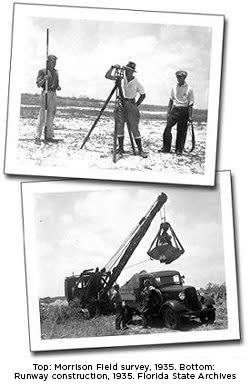
Commercially, President Donald J. Trump International Airport began in 1936 when it was known as Morrison Field. It was named for Miss Grace K. Morrison, who was a pioneer in the early planning and organizing of the area, which culminated in the establishment of the field. The inaugural airline flight was made by a New York-bound Eastern Air Lines DC-2 in 1936. Eastern Air Lines' daily northbound service originated in Miami, stopped in West Palm Beach and 11 additional cities, and arrived in New York approximately 13 1/2 hours after departing Morrison Field. The field was officially dedicated and opened on Dec. 19, 1936, with nothing more than the strip itself and a small administration building.
In January 1937, Palm Beach Aero Corporation obtained a five-year lease for a hangar site and fixed base operational privileges. The first hangar, along with ramps and facilities, was ready for use by flights at a small building on the south side of the airport, which became known as the Eastern Air Lines Terminal.
As World War II approached, Morrison Field assumed an increasingly important military role. In November 1940, the U.S. Army Air Corps began converting the airport for military use, officially activating it in 1941. Commercial and private aviation operations were relocated to LNA, located approximately six miles to the south. During the war, Morrison Field became a major military transportation hub. Following the Allied Buildup for the invasion of Europe, more than 6,200 aircraft and 45,000 airmen passed through the facility, many departing for missions associated with the D-Day invasion of Normandy.
In 1947, the operations of the Air Transport Command were transferred to Mobile, Alabama, and Morrison Field was deactivated on June 30, 1947. In September 1947, Palm Beach County took over the two-story Air Force operations building on the north side of the airport for use as a passenger terminal.
Recognizing the value of the internationally recognized Palm Beach name for tourism and economic development, the Palm Beach County Board of County Commissioners voted on Aug. 11, 1948, to officially rename Morrison Field as Palm Beach International Airport.
The airport briefly returned to military service during the Korean War when Morrison Air Force Base was reactivated in 1951.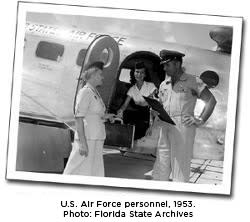 Civilian operations were once again relocated to facilities on the south side of the field. Nearly 23,000 airmen trained in West Palm Beach during the conflict. Following the war, Palm Beach County regained full operational control of the airport in 1959.
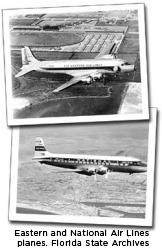
Throughout the 1940s, air service in West Palm Beach was provided exclusively by Eastern Air Lines and National Airlines. The airport's commercial service expanded in the following decade, beginning with Bahamasair in 1950. Q Airways commenced operations in 1952, followed by Mackey Airlines in 1953. Riddle Airlines began providing air freight service in 1955, while Capital Airlines briefly served the airport in 1954. Delta Air Lines introduced DC-7 service in 1960, and United Airlines began operations the following year, further expanding travel options for the region.
 In the 1950s, passengers left the airport through the County's first permanent terminal located on Southern Boulevard. The terminal cost nearly $125,000 to build and was demolished in 1991.
In 1960, ownership of the airport's approximately 2,000 acres was formally transferred to Palm Beach County. As passenger demand increased, expansion became necessary. Frequent visits by President John F. Kennedy aboard Air Force One brought additional national attention to the airport. Following voter support for expansion rather than relocation, major improvements were funded through a bond initiative, leading to the construction of new facilities and infrastructure.
The airport's main terminal was dedicated on Oct. 29, 1966, marking a significant milestone in its modernization. Additional improvements followed, including a new air traffic control tower and a second terminal constructed by Delta Air Lines in 1974.
On Oct. 23, 1988, the David McCampbell Terminal was officially dedicated. Named in honor of World War II naval flying ace, Medal of Honor recipient and Palm Beach County resident David McCampbell, the facility represented a major investment in the airport's future. Funded through approximately $150 million in revenue bonds, the terminal doubled the airport's gate capacity and established the foundation for continued growth.
On July 9, 2026, Palm Beach International Airport was officially renamed President Donald J. Trump International Airport following the enactment of state legislation authorizing the change, in honor of the nation’s 45th and 47th president. The ICAO code was updated at that time, while the IATA code will transition from PBI to DJT on Aug. 18, 2026.
Today, President Donald J. Trump International Airport serves millions of passengers annually and remains a critical transportation gateway for Palm Beach County, supporting tourism, business travel, international commerce and regional economic development while continuing a legacy that spans nearly a century of aviation history.